AI taking over most of our routine work was never in doubt. With AI agents, and now agentic AI, it is only happening sooner, and for the good, if you ask us. The term gets thrown around in every other LinkedIn post and job description, but very few can explain the agentic AI meaning without fumbling.
This blog aims at just that: learn what it is, how it works, the tools, a roadmap, and projects worth your time. If you’d rather learn it with a mentor, our agentic AI course in Bangalore covers the same ground.
What Is Agentic AI? Meaning and Definition
It’s AI you hand a goal to, and it figures out the rest. It’s AI you hand a goal to, and it figures out the rest. Unlike conventional models, agentic AI can perform actions by accessing tools with such autonomy. It ultimately comes down to five traits:
- Goal-driven: accomplishes a task on its own.
- Planning: compartmentalizes the plan into smaller achievable goals.
- Tool use: search, databases, APIs, code
- Memory and context: records every interaction and prompt and implies it wherever it is needed.
- Feedback and oversight: mostly checks itself, asks you before risky moves
To understand it more deeply, if you keyed in “Suggest hotels under ₹1,500,” you’d get a list; that’s about it. “Book one for Saturday and add it to my calendar” gets an agentic system to search, compare, and ask before paying, and book and block the date. That’s the agentic AI meaning at work. The world doesn’t celebrate agentic AI’s anniversary, as its inception is still a mystery.
Agentic AI vs AI Agents vs Generative AI: What Is the Difference?
| Basis | Generative AI | AI Agent | Agentic AI |
| Main job | Reacts and responds to prompts with text, images, or code. | Finishes one defined task with tools | Accomplishes a goal, from planning to execution |
| Autonomy | Nil by default; works independently only with thoroughly engineered prompts | Medium, acts alone within one task | High, within limits you set |
| Example | Helps you find cheap hotels | Checks room availability for your dates | Finds and books the hotel upon your confirmation |
| Human role | Prompts it, checks each answer | Assigns the task, reviews the result | Sets goals and limits, approves key steps |
Definitions vary slightly across sources. The difference between agentic AI and AI agents? It is the size. An agent performs one task with tools. Agentic AI systems coordinate one or more agents toward a goal. The striking contrast lies in its action. Agentic AI acts, but it still reasons with GenAI, which our generative AI course in Bangalore teaches very comprehensively. Want to start with generative AI? Our Generative AI course in Bangalore builds that base.
How Agentic AI Works: Architecture, Workflows, and Design Patterns
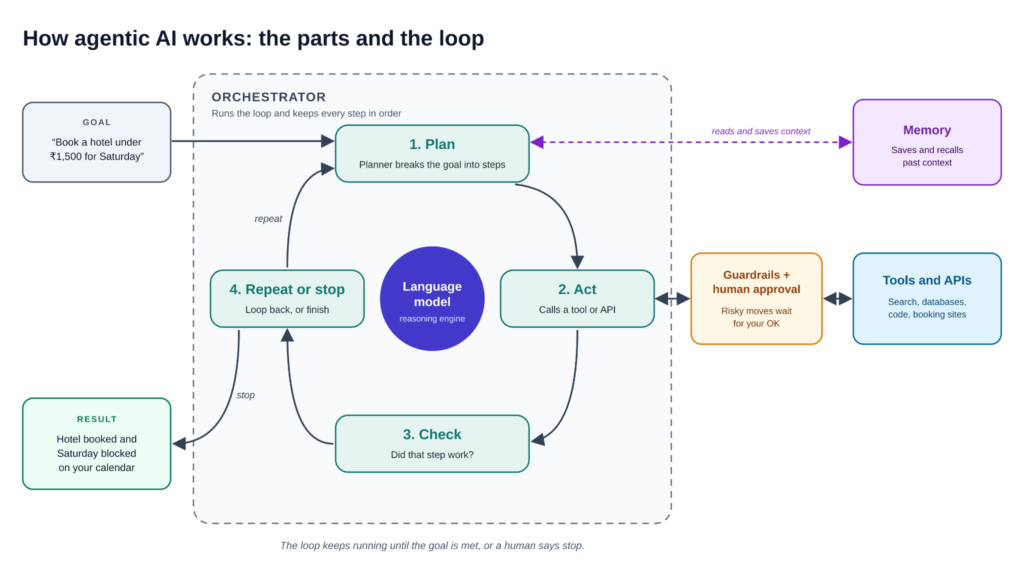
An agentic workflow begins with understanding the goals, laying out the tasks by planning, executing them using tools, and lastly evaluating the results. Agentic AI differentiates itself from generative models by performing a large number of tasks to attain the desired objective.
Agentic AI architecture (components)
An agentic AI architecture consists of many components functioning together:
- Language model: It is the reasoning engine and understands the prompts or instructions.
- Planner: Organizes exceptionally difficult tasks into smaller, attainable ones.
- Memory: Preserves and saves relevant information from older interactions.
- Tools and APIs: Connect to external applications and data sources.
- Orchestrator: Oversees it all by coordinating tasks and managing executions.
- Guardrails and human approval: Set boundaries and require human intervention for sensitive or important decisions.
Agentic workflows vs fully autonomous agents
Agentic workflows follow a system that is laid out, and the AI is the one that calls for the shot. Fully autonomous agents have more freedom. It has the liberty to choose the steps to take, and can choose a tool of its choice and can solve problems at its own prerogative. Agentic workflows are better if you are just starting out as they are simpler to use. Greater autonomy would need some training and understanding.
Common agentic design patterns
- Reflection: Reviews its previous output, identifies gaps, and makes improvements
- Tool use: Uses external tools such as search engines, databases, and APIs to complete tasks
- Planning: Breaks down a larger objective into manageable steps
- Multi-agent collaboration: Summons specialized agents, where each becomes responsible for a different part of the task
Many agents run on ReAct (reason and act): think, act, check, repeat.
Agentic AI Use Cases and Real-World Examples
Many agentic AI use cases sit in repetitive work nobody enjoys, which is exactly why companies are keen to invest in it. Take any Monday at an Indian office. Support’s agent clears easy weekend tickets and escalates angry ones. IT’s agent resets passwords with an approved script. Pull requests get reviewed and tested before morning chai.
Finance’s agent matches invoices to bank records; HR chases new joiners for documents. Agentic marketing pauses ads no one clicked, while agentic AI for identity security locks odd 2 a.m. logins. These examples of agentic AI still leave big calls to a person.
Businesses either buy ready-made agentic AI solutions or build their own. And both need people who know how these systems work. Engineering never goes out of trend.
Agentic AI Tools and Platforms for Beginners
Google “what are agentic AI tools,” and you’ll drown in names; half of them launched last month. Here are some of them along with its best applications:
| What you need | Tools | Best application |
| Agent-building framework | LangChain, LangGraph, CrewAI | Laying down how your agent plans, acts and checks itself, even when several agents share the work |
| Storage for documents and memory | LlamaIndex, Pinecone, Chroma | Storing your files and fetching the right bit of information when the agent asks for it |
| The language model | OpenAI, Anthropic, Hugging Face models | Understanding your instructions and working out what the agent should do next |
| Deployment | FastAPI, Docker, Vertex AI | Hosting your agent as a proper app instead of a file on your laptop |
| Monitoring and testing | LangSmith | Keeping a log of the agent’s actions, which makes finding mistakes much easier |
Every tool above is covered somewhere in our courses.
Skills Needed to Learn Agentic AI
You don’t need all the skills for agentic AI below on day one, nail the top four and pick up the rest along the way.
- Python programming: Nearly every agent tutorial expects it. Mostly, it’s short scripts that glue tools together.
- Problem framing: Stops you from automating a mess. Decide early what the agent may and may not do.
- Prompt engineering: Every decision your agent takes starts here. Write prompts so clear the model can’t drift.
- Working with APIs and JSON: This is how agents book, send, or fetch things through tool calls in a fixed format.
- Setting up RAG (retrieval): The model quotes your sources instead of guessing, like pulling the right paragraph out of your PDFs.
- Agent orchestration: Someone has to track which agent does what. That’s what LangGraph or CrewAI workflows are for.
- Testing and evaluation: Agents can be confidently wrong. Test questions, logs, and failure post-mortems keep them honest.
- Cloud deployment and data handling: It has to run beyond your laptop, which means hosting it, feeding it data, and hiding the keys.
Starting from zero? Our Python with AI course sorts out the basics, and the Deep Learning course takes you further once you’re comfortable.Agentic AI Roadmap and Learning Path
Agentic AI Roadmap and Learning Path
So, if you visited our Bangalore classroom tomorrow, asking, “How do we build an agentic AI,” then this is the agentic AI roadmap we’d provide you with. Six stages, and no cutting to the good part.
Stage 1: Python
Loops, functions, files, and API calls. Make it easy to practice by renaming 100 holiday images using one script.
Stage 2: LLMs and prompts
The model can only guess its next word – vague prompts will yield vague responses. Use three different prompts with one leaf letter.
Stage 3: Tool calling and JSON
If an agent cannot push buttons, then it’s not an agent. Have your code hand the details in JSON, as the model selects a tool to work with.
Stage 4: RAG and vector databases
Ask a model when your car is due for service, and it will give you a straight face. Store the manual in a vector database, add RAG, and then it looks first.
Stage 5: Single agent and small crew
Construct a LangGraph or CrewAI agent that can generate dummy bank SMSes and then explain the mechanism of disappearance of your salary. Self-organize and self-review, and invoke cooperation of 2-3 agents.
The agentic learning trajectory followed by a coder, an analyst, and a commerce graduate will not be the same! If you are a coder full-time, go directly to Stage 3. Analysts and data scientists use SQL and Python on a weekly basis; agents just sit on top of that, and our Data Science course or this article on a career in data analytics can fill the voids. Not coming from an IT background? Double the time allotted for Stages 1 and 2.
Agentic AI Projects for Beginners
Try these agentic AI project ideas, one for each level:
- Beginner: An early morning news agent that fetches live stories on a topic you pick. It teaches you to use tools and write prompts that don’t wander.
- Intermediate: A Q&A bot over public RBI circulars or your own class notes. You learn RAG, memory, and how to pick the right paragraph.
- Advanced: Take your best project live on the cloud, with tracing turned on for obvious reasons. Reliability, cost, and monitoring suddenly become your problem.
Put the finished ones on GitHub with a README that admits what broke and how you fixed it. Interviewers ask about the broken bits of agentic AI projects first.
From Demo to Production: What Agentic AI Systems Need
Your demo would have worked once and without any mistakes. That’s not the case for agentic AI production systems. They need:
• Testing of messy cases
• Guardrails, so it only touches what you allow
• With a click from a human, a nod on a shaky move
• It is critical to keep logs of all decisions; monitoring AI movements is imperative.
• Free and rapid cost and swiftness reviews
Throw in clean data pipelines, cloud hosting, and hidden API keys- all pure engineering- and a Data Engineer course and training on AWS, for agentic AI systems.
How to Choose the Best Agentic AI Course or Certification
The best agentic AI course comes down to the persons educational background and interests. Here’s how to choose:
• Ask the tutor or the manager if they’d teach Python, LLMs, tool calling, RAG, frameworks, and evaluation, or just prompts?
• Will you leave with GitHub projects on public data and mock interviews experience to handle the intensity?
• Will a mentor read your code and mark it down and give it their approval?
• Does the certificate list your skills? Are placement terms written? Neither means a guarantee of employment.
• Shift timings changing? See if any batches are open, both online and offline.
Take our Agentic AI course as you would in any agentic AI certification course, and then do a comparison with our IT courses in Bangalore guide.
FAQs About Agentic AI for Beginners
What exactly defines agentic AI?
Set up a goal, for instance, renew your bike insurance before Friday. It calls up plans, fills in required forms and verifies everything before paying out to you. That’s the agentic AI meaning.
1) When was agentic AI launched?
The exact date is unknown. Around 2024, “agentic” got popular when LLM-based agents began to make plans.
2) How does agentic AI help with identity security?
It monitors who logs in, where, and how he logs in. If an agent receives an intern’s request for payroll information at midnight, it will not allow any transactions to proceed and will document the request.
3) Which agentic AI tools should I master first?
LangGraph or CrewAI. While yours may need to read PDFs, LlamaIndex steps in; LangSmith, for replaying the mistakes. Agentic AI tools such as Vertex AI are relevant when it comes to launch.
4) Is agentic marketing and automation the same?
No, not quite. Rules are programmed in; automation does what you wrote. Agentic marketing enables AI-powered agents to analyze campaign metrics, compose new variations, and autonomously deselect underperforming ads, albeit with a marketer’s approval, thereby minimizing human involvement.
5) How can I build an agentic AI when you’re starting from zero?
Choose one problem to solve initially. Learn Python, get the agentic AI meaning at once and follow our agentic AI roadmap above until it is corrected by an agent.
Final Word
Before you step into the new age, get the agentic AI meaning clear, keep your Python sharp and finish two small projects. Anyone promising a guaranteed job is selling a dream. No clue where you fit? Talk to the Talent Edo team and we’ll map an agentic AI learning path around your background.